End Stranger Anxiety In Your Dog
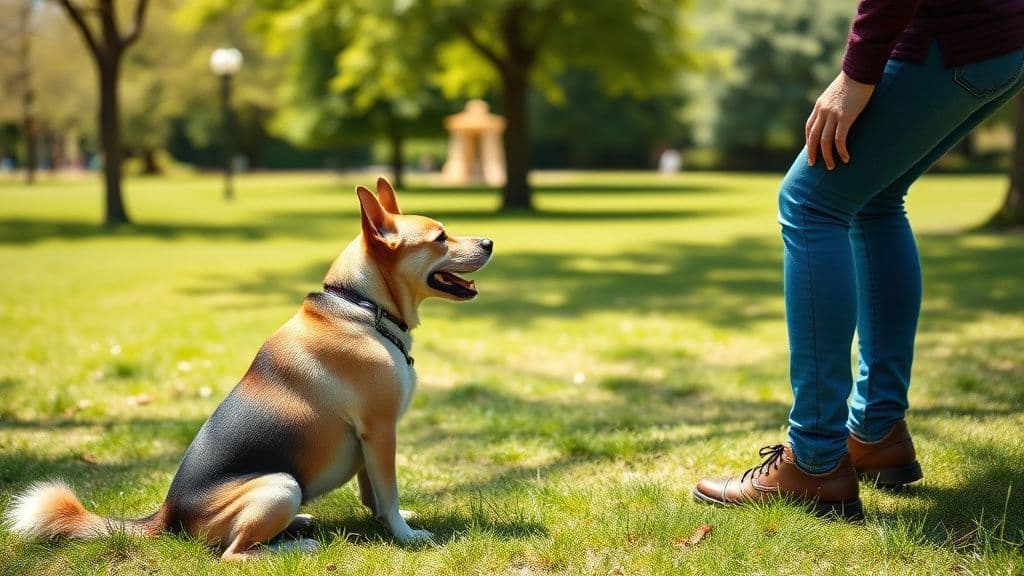
Calm your dog's fear of strangers by building positive associations instead of scolding.
To stop dog barking at strangers by changing emotional response, you must use desensitization and counter conditioning. This involves keeping your dog at a distance where they notice a stranger but are calm, then continuously feeding them high value treats until the stranger leaves, creating a positive association. The process hinges on managing distance to keep your dog under threshold.

Your dog barks at the mail carrier, at guests, at anyone walking by the window. It's loud, it's persistent, and it can turn a simple visit into a stressful ordeal. Many owners try to shout over the barking or punish their dog, but that often just adds to the chaos and fear. I've seen this countless times. The truth is, barking at strangers is rarely about disobedience. It's a window into your dog's emotional state: fear, anxiety, or even overexcitement. The most effective way to stop it is not by punishing the bark, but by changing your dog's underlying feelings about strangers from the inside out.
The good news is you can do this. By understanding why your dog barks and applying a proven, gentle training method, you can help your dog feel safer and more relaxed. You'll build trust and create a more peaceful home for everyone.
Why Do Dogs Bark at Strangers?
Before you can fix a behavior, you need to understand its root cause. Barking is communication. When your dog barks at a stranger, they are trying to tell you something. The ASPCA categorizes this type of barking as either a "greeting" bark or a more serious "territorial/alarm" bark that essentially means, "You're not welcome at my place!" The treatment path differs significantly based on which one you're dealing with.
Common reasons include:
* Fear or Anxiety: This is a major driver. A stranger represents the unknown. Your dog may feel threatened and bark to make the scary person go away.
* Territorial Behavior: Your dog sees your home and yard as their domain. Strangers are intruders who must be warned off.
* Overexcitement: Some dogs, especially friendly ones, bark from a place of frantic joy. They're so overwhelmed they don't know how else to express it.
* Lack of Socialization: Dogs who weren't exposed to a variety of people in a positive way during their critical development periods may be more wary of strangers.
* Learned Behavior: If barking has historically made the stranger leave (from the dog's perspective), the behavior is reinforced. It worked!
The experts at Dog Gone Problems emphasize that helping a dog feel good about the thing they bark at is a crucial element. This shifts our focus from the symptom (the bark) to the core issue (the negative emotion). It's the difference between treating a fever and treating the infection that caused it.
The Core Method: Desensitization & Counter Conditioning
This is the proven, science backed method referenced across all our research, from My Pet Niche to the ASPCA. It's a one two punch that rewires your dog's brain.
* Desensitization means gradual exposure. You don't start by having a stranger ring your doorbell. You start with the stranger so far away that your dog notices them but doesn't react. This is called being "under threshold." The AKC notes that a busy entryway might simply be "too much for them to handle emotionally." We start easy.
* Counter Conditioning means creating a new, positive association. We want your dog to think, "Stranger appears = amazing things happen for me!" This replaces the old thought of, "Stranger appears = I must sound the alarm!"
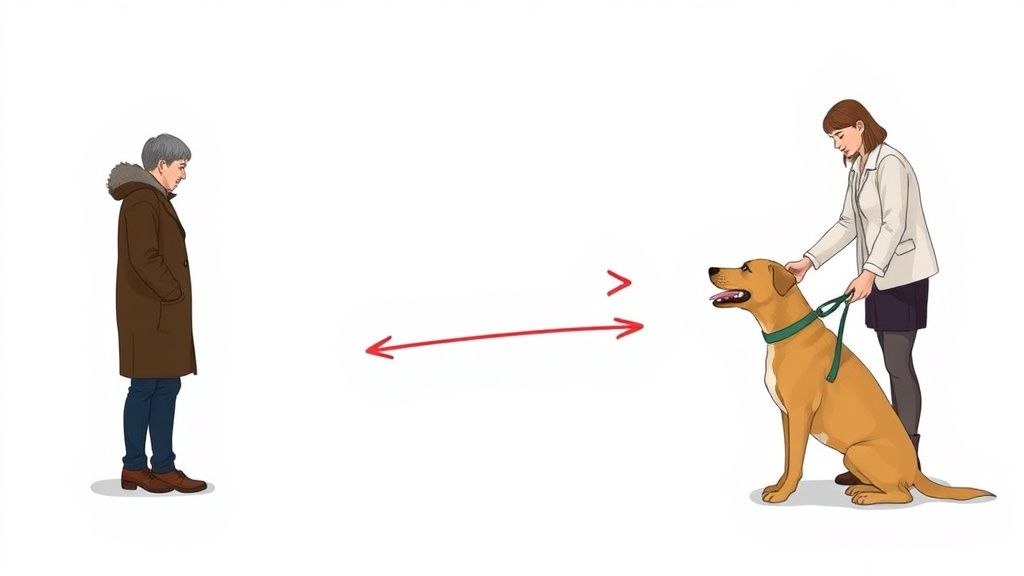
A Reddit user on r/Dogtraining perfectly outlined the basic drill: "At a distance where he notices a stranger (stimuli) but is not barking/reacting ('under threshold'), you feed the dog really great treats until the stimuli leaves, then you stop feeding."
The treat must be something your dog goes crazy for, something truly high value. This might be small pieces of boiled chicken, cheese, or a special dog food delivery that you reserve for training. The quality of the reward matters.
Step-by-Step Training Plan to Change Emotional Response
Now, let's break this down into actionable steps you can follow. Patience and consistency are your best tools here.
Step 1: Manage the Environment
You cannot train if your dog is constantly being triggered. Management prevents rehearsing the bad behavior while you work on the solution.
* Use baby gates or an exercise pen to keep your dog away from front windows and doors, as suggested by the AKC.
* Close blinds or use static window film to block the view of the sidewalk.
* For walks, create space. Cross the street or use parked cars as a visual barrier when you see a stranger approaching.
* This isn't giving up. It's setting the stage for successful learning, just like the team at Dog Gone Problems did by managing the distance for dogs like Charlie and Bobo.
Step 2: Find the "Sweet Spot" Distance
This is the most critical part. With a helper (a friend your dog doesn't know well is ideal), find the distance at which your dog sees the stranger but remains calm. Their ears might perk up, they might stare, but they are not barking, lunging, or whining. This could be 50 feet away, or across a large park.
Step 3: Create the Positive Association
At this "sweet spot" distance, the moment your dog looks at the stranger, start feeding a constant stream of those high value treats. Use a happy, calm voice. You're not asking for a sit or any other behavior. You are simply pairing the sight of the stranger with fantastic food.
* Keep feeding as long as the stranger is in view.
* The stranger should be mostly still and non threatening at this stage.
* When the stranger walks away and out of sight, the treats stop.
Repeat this many times over several sessions. You are building a neural pathway: stranger = chicken. The goal is to see a change in your dog's body language. You might see them glance at the stranger and then immediately look to you for a treat. That's a great sign!
Step 4: Gradually Decrease the Distance
Over many sessions, when your dog is visibly happy and expectant upon seeing the stranger at the current distance, your helper can take one small step closer. If your dog stays calm and happy, keep treating. If they bark or tense up, you've moved too fast. Have the helper step back to the previous distance and succeed there some more.
The process at Dog Gone Problems with Reggie, who barked when people stood up, followed this pattern. They started by holding up a treat, standing, then treating. Eventually, the person could stand and walk across the room before the treat was given.
Step 5: Add Variation and Real-World Practice
Once your dog is comfortable with a specific helper at closer distances, generalize the training.
* Practice with different "strangers" (friends and family your dog doesn't live with).
* Practice in different locations (your yard, a quiet park, outside a coffee shop).
* Add mild movement, like having the stranger walk slowly parallel to you at a distance.
* You can also begin to ask for simple behaviors like "sit" or "look at me" before the treat is delivered, moving toward what PrideBites calls "response substitution."
What NOT to Do: Common Mistakes
Some well intentioned actions can actually make the problem worse.
* Do Not Yell or Punish: Shouting "No!" or "Quiet!" often just sounds like you're barking along with them, which can amp them up more. Punishment can also increase their anxiety, making the stranger seem even scarier.
* Do Not Force Interactions: Never force your fearful dog to "say hello" to a stranger. This can be traumatic and deepen their fear.
* Do Not Rush the Process: Moving too close, too fast will cause your dog to go "over threshold." If they bark, you've lost that round. It's not a setback, but it means you need to increase distance next time.
* Do Not Use Low Value Treats: This is hard emotional work for your dog. They deserve the best dog treats you can offer to make a strong impression.
Tools and Products That Can Help
While the training work is done by you, a few tools can support your efforts.
* High Value Treats: This is non negotiable. Have a dedicated "stranger training" pouch filled with something irresistible. Many owners find that a dog subscription box is a great way to discover new, exciting treats to keep their dog motivated.
* A Sturdy Harness: For safety and control on walks while you create distance.
* A "Find It" Cue: Teaching your dog to sniff the ground for tossed treats can be a brilliant way to break their fixation on a stranger and lower their arousal.
* White Noise Machine: Helps mask outside sounds that might trigger barking when you're not actively training.
Remember, tools are aids, not solutions. The core of the change is the systematic, patient work of desensitization and counter conditioning.
When to Seek Professional Help
This method is powerful, but some situations call for expert backup. If your dog's barking is accompanied by snarling, snapping, or lunging with intense body stiffness, you may be dealing with more than fear based barking. This could be aggression rooted in deep anxiety or a negative history. In these cases, a certified professional dog trainer or a veterinary behaviorist can provide a safe, structured plan tailored to your dog. They can also rule out any medical issues that might be contributing to the behavior.
Final Thoughts
Stopping your dog from barking at strangers isn't about suppression. It's about transformation. It's about guiding your dog from a state of worry or over excitement to a state of calm confidence. By focusing on changing their emotional response through desensitization and counter conditioning, you're not just teaching a quiet command. You're building trust, reducing their stress, and improving their overall quality of life.
The journey requires observation, patience, and a pocket full of chicken. Celebrate the small victories: the first time your dog glances at a passerby and then looks to you, or the moment a guest enters without a chorus of barks. Those are the real milestones. For more on building a strong bond with your dog through positive training, explore our other guides on building confidence in shy dogs. Your peaceful, happier home is not just a hope. It's a very achievable reality.
Recommended Products



Find the Perfect Box for Your Dog
Compare top-rated dog subscription boxes and find the best fit for your pup.
Compare Boxes