Master Dog Food Calories With WSAVA 2026

Master the WSAVA 2026 chart to accurately calculate your dog's ideal daily calories for optimal health.
The WSAVA 2026 chart provides a starting point for your dog's daily calorie needs based on weight, using formulas like (30 x weight in kg) + 70. However, it's just a baseline; your dog's exact needs are influenced by life stage, activity level, and body condition, which is why tools like the Dog Food Calculator 2026 and professional veterinary advice are essential for precise portioning.

You've stood in the pet food aisle, bag in hand, and wondered, "Is this the right amount?" You're not alone. With over 56% of dogs in America considered overweight or obese, proper portion control is one of the most powerful yet overlooked tools in pet care. As a dog writer who's talked with countless owners, I've seen the confusion firsthand. We want to do right by our dogs, but the numbers on the bag are often one size fits all, and our unique pups are anything but. That's where understanding calories and using trusted resources becomes your secret weapon. The World Small Animal Veterinary Association (WSAVA) provides a crucial framework for this, and their evolving guidelines, including a handy calorie chart, are designed to cut through the noise. Let's decode how to use this information to feed your dog with confidence.
What is the WSAVA and Why Should You Listen to Them?
The World Small Animal Veterinary Association isn't a pet food company. They're a global community of veterinary professionals dedicated to advancing the health and welfare of companion animals. Their mission is to provide science based guidance, free from commercial bias. In 2011, they launched their Global Nutrition Guidelines, and they've been building a toolkit ever since to help vets and pet owners make better nutritional choices.
Think of them as the neutral experts in the room. They don't endorse brands. Instead, they give you the questions to ask so you can be your own best advocate for your dog. Their resources, like the nutritional assessment checklists and body condition score charts, are all about creating a complete picture of your dog's health. The calorie recommendations are one piece of that puzzle, a foundational piece that helps prevent the slippery slope to weight gain. When you use a WSAVA aligned approach, you're using the same framework your veterinarian uses, which makes those vet visits much more productive.
Decoding the WSAVA 2026 Calorie Chart: Your Starting Point
The WSAVA Global Nutrition Toolkit includes a "quick one page chart" that lists starting points for calorie needs. It's intentionally simple. For a healthy adult dog, a common formula cited is: Daily calories = (30 × weight in kg) + 70.
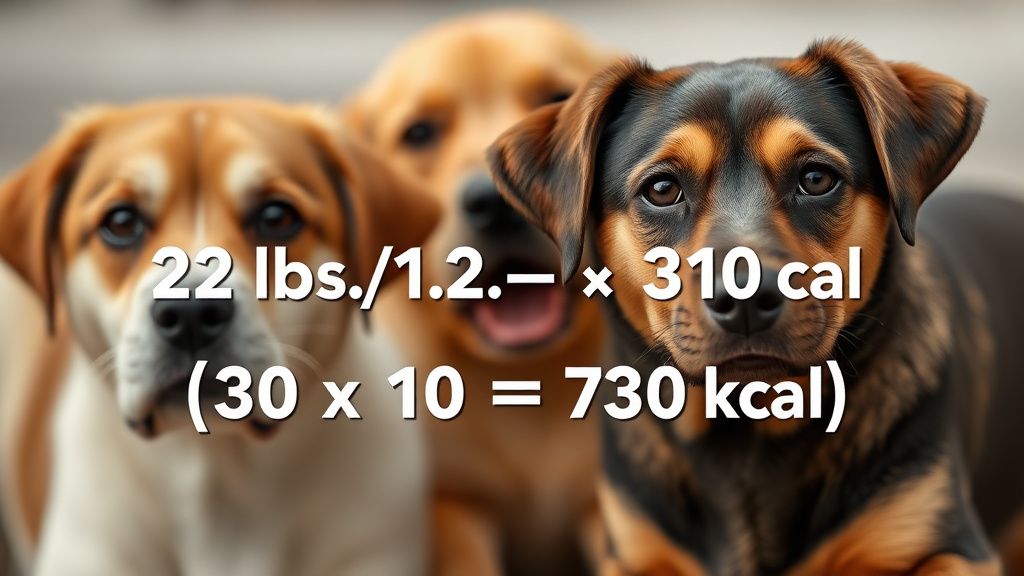
Let's break that down with a real example. Say you have a 22-pound dog. First, convert pounds to kilograms by dividing by 2.2. So, 22 lbs / 2.2 = 10 kg. Plug that into the formula:
(30 x 10) + 70 = 300 + 70 = 370 kilocalories (kcal) per day.
That 370 kcal is your starting line, not your finish line. The chart and formula provide a Resting Energy Requirement (RER) baseline for a typical, moderately active, adult dog in ideal body condition. The WSAVA itself states these are "starting points." It's the number you tweak and adjust based on the living, breathing dog in front of you. This is where many owners go wrong; they either stick rigidly to a bag's guideline or to this baseline number without making necessary adjustments. A great next step is to use a dedicated dog food calculator that builds on this baseline by factoring in the variables we'll discuss next.
The 3 Key Factors That Change Your Dog's Calorie Needs
Your dog's 370 kcal daily requirement is a dynamic number. Three primary factors will move it up or down, sometimes significantly.
Life Stage: A growing puppy burns energy at an incredible rate. They often need more than double the calories per pound than an adult dog. Conversely, a senior dog's metabolism slows down. They may need 20-30% fewer calories than they did in their prime adult years to avoid weight gain. The WSAVA toolkit includes different considerations for these life stages, emphasizing that nutritional assessment is an ongoing process. Activity Level: This is the most variable factor. Compare a couch potato Bulldog to a collie" class="text-yellow-600 hover:text-yellow-700 underline">Border Collie who herds sheep all day. The formula's "moderately active" is a broad middle ground. A true working dog or an agility athlete might need 1.8 to 2.5 times their RER. A sedentary pet might only need 1.2 times their RER. Honestly assess your dog's daily exercise. That afternoon walk plus a game of fetch? That's likely moderate. Just a short bathroom walk? That's leaning toward low activity. Body Condition Score (BCS): This is the most important feedback loop. The WSAVA provides body condition score charts because the scale doesn't tell the whole story. You should be able to easily feel your dog's ribs with a slight fat covering, and they should have a visible waist when viewed from above. If your dog is already overweight, you must feed for their *ideal* weight, not their current weight. If they're underweight, you'll need to increase calories. Weighing your dog monthly and tracking their BCS is non negotiable for good care.How to Apply This Knowledge: A Step by Step Feeding Plan
Knowing the numbers is useless without a plan. Let's create one.
1. Calculate Your Baseline. Use the formula: (30 x ideal weight in kg) + 70. If your dog's at their ideal weight, use their current weight. If not, use the weight they *should* be. You can find ideal weight ranges for breeds online or ask your vet.
2. Apply a Multiplier. Use your best judgment on activity level. For most pet dogs, start with a multiplier of 1.4 to 1.6. So, for our 10kg dog: 370 kcal x 1.5 = 555 kcal per day.
3. Check the Food Label. Find the "kcal per cup" or "kcal per kg" on your dog's food bag. This is critical. Brands vary wildly. A cup of one food could be 300 kcal, while a cup of another could be 450 kcal. You cannot measure accurately without this number.
4. Do the Math. If your dog's food is 350 kcal per cup and their daily need is 555 kcal, then 555 / 350 = ~1.6 cups per day.
5. Implement and Monitor. Split that 1.6 cups into two meals. For a month, stick to this amount, weigh your dog weekly, and assess their body condition. Is their waist disappearing? Reduce by 10%. Are their ribs becoming too prominent? Increase by 10%. This is the art and science of dog feeding.
Remember to account for everything that goes in their mouth. Those best dog treats you give during training, the scraps from dinner, the peanut butter in the Kong, it all counts. If you use a lot of treats, consider using a portion of their daily kibble as training rewards or choosing very low calorie options. For owners who love convenience without sacrificing precision, a dog food delivery service for fresh meals can take the math off your plate, as they often pre portion based on your dog's profile.
Common Pitfalls and How to Avoid Them
Even with the best plan, it's easy to stumble. Here are the big ones.
Blindly Trusting the Bag. The feeding guidelines on commercial food are, by necessity, extremely broad. They cover everything from a lazy senior to an active young adult. Starting at the middle to low end of the bag's range and adjusting based on your dog is a smarter strategy. Forgetting About "Other" Food. As mentioned, treats are a major culprit. So are dental chews, stuffed toys, and even some medications hidden in food. Keep a mental tally. If you had a big training day, slightly reduce dinner. Not Reassessing. Your dog's needs change. They get spayed or neutered (which can lower metabolic rate). The seasons change, reducing outdoor activity. They age. Make nutritional assessment a regular part of your routine, just like vet checkups. The WSAVA emphasizes this as a continuous process, not a one time event. Choosing Food Based on Marketing. The WSAVA provides key questions to ask manufacturers: Who formulates your diets? Do you employ a full time qualified nutritionist? What specific quality controls do you have? Where are your foods produced and manufactured? Companies that are transparent, employ experts, and conduct feeding trials are generally making a more reliable product. Be wary of brands that can't or won't answer these questions clearly.Final Thoughts
Decoding your dog's calories isn't about complex math or deprivation. It's about mindful care. Using the WSAVA 2026 chart as your scientific starting point, then layering in your intimate knowledge of your dog's body, energy, and life stage, empowers you to be their best health advocate. This process turns feeding from a chore into an act of love, one that directly contributes to a longer, more vibrant life together.
Don't let perfect be the enemy of good. Start today. Weigh your dog, feel for their ribs, calculate that baseline number, and look at the label on your food bag. That simple act puts you ahead of the curve. And remember, you're not alone in this. Your veterinarian is your ultimate partner. Bring your notes, your questions, and your WSAVA toolkit knowledge to your next appointment. It might just be the most productive checkup you've ever had. For more on creating a stress free routine that supports overall wellness, including managing mealtime anxiety, our dog anxiety guide offers helpful strategies.
Find the Perfect Box for Your Dog
Compare top-rated dog subscription boxes and find the best fit for your pup.
Compare Boxes